KLARSICHT
Prioritizing AI initiatives — facts over gut feel
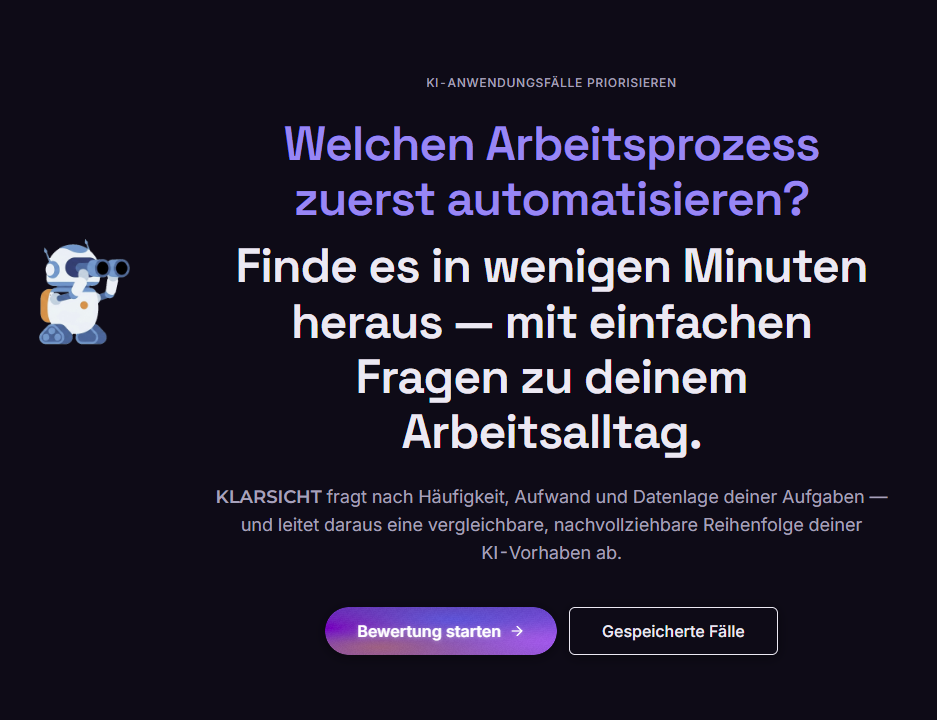
A guided prioritization tool for automating work processes with AI. It helps AI consultants and business units make the right decisions. With KLARSICHT, teams can better assess which work processes they should automate and prioritize in the first place — based on facts, not gut feel.
The Problem
Lack of systematics: In many classic workshops, selecting which work processes to automate fails for lack of a systematic approach. Teams prioritize the processes that cost the most time or money or are articulated most loudly in meetings, without asking the same relevant questions about the other work processes. Decisions are made before anything is compared.
No consideration of risks and feasibility: When a work process is on the table, people often ask a generic AI chatbot: “How do we automate this?” The answer comes without the concrete workflow, without a clear risk assessment, and without separating today’s effort from expected benefit. Often nobody checks whether the data foundation and systems allow automation at all. Suggestions can sound convincing at first but do not hold up, because neither the criteria for successful automation nor for prioritization were defined upfront.
Project Highlights & Creative Process
The Solution:
KLARSICHT turns everyday knowledge into a structured prioritization layer along three analytical dimensions:
- Fact-based scoring: Six concrete questions instead of self-assigned grades — frequency, duration, people involved, impact (“Who notices if this work sits undone?”), data readiness, repeatability. That yields a value score and a feasibility score, plus a baseline of tied-up working time (frequency × duration × people, in hours per month). Risk is not a seventh criterion; it is its own ranking rule (low / manageable / high / unacceptable). If the risk is “unacceptable,” the case drops out of the ranking without distorting the value score.
- Archetype classification (backend only): The described workflow is mapped internally to one of seven patterns (classification, extraction, summarization, drafting, knowledge retrieval, transformation, matching) — invisible to the user, as a guardrail against made-up AI promises. Two phases: Phase 1 returns an archetype and a risk suggestion in the background; Phase 2, after the facts and the chosen risk, generates 2–4 automation options (AI agent, workflow, assistant, other), including pitfalls, main risks, and a reasoned recommendation (“Closest to your case”). The LLM runs on Groq (gpt-oss), with a strict JSON schema and A/B evaluation against real test cases.
- Portfolio ranking: Save, filter, search, and manually reorder cases — risk as a sort rule, not a vanity score. Results view with score, baseline, and example directions inline (no extra wizard step). Light/dark design system (Space Grotesk + Inter, mesh gradient), a guided flow with no facilitator. Storage stays local in the browser, deliberately without task management and without converting time into money.
Not a chatbot for “something with AI.” A shared ranking that business units and consultants can stand behind — because it comes from everyday work, not from the loudest voice in the room.